TheMostReadBook.org

An English translation of the Quran that is as close as possible to the Arabic sacred text
View active topics
  Verse(s):    
View unanswered posts


Forum locked This topic is locked, you cannot edit posts or make further replies.  [ 194 posts ]  Go to page Previous  1 ... 5, 6, 7, 8, 9, 10, 11 ... 20  Next
Author Message
 Post subject: Re: Scholars opinions about abrogation
PostPosted: 15 Jun 2010, 03:05 
Offline
Site Admin
User avatar

Joined: 04 May 2009, 16:10
Posts: 4558
Location: USA
In his book الإحكام في أصول الأحكام, page 484, Ibn Hazm (Az-Zhaahiri?) wrote the decisive word about the abrogation doctrine, which has been my main point for rejecting the doctrine:

ولا يحل لأحد أن يقول في شيئ من الأوامر إن هذا منسوخ إلا ببرهان جلي إذ كلها على وجوب الطاعة لها وماتيقنا وجوب طاعتنا له فحرام علينا مخالفته لقول قائل هذا منسوخ

Translation:
It is unlawful for anyone to say about any of the commands, "This is abrogated", except with obvious proof, since they are all to be obeyed, and what we are certain about our obligation to obey, it is forbidden for us to do differently because somebody said it is abrogated.

As plain and logical that statement is, I have to wonder why the abrogation doctrine took hold all these centuries.

_________________
A candle loses nothing by lighting another candle.


Top
 Profile  
 
 Post subject: Re: Scholars opinions about abrogation
PostPosted: 15 Jun 2010, 03:37 
Offline
User avatar

Joined: 05 May 2009, 00:16
Posts: 1839
Location: USA
Linguistic wrote:
In his book الإحكام في أصول الأحكام, page 484, Ibn Hazm (Az-Zhaahiri?) wrote the decisive word about the abrogation doctrine, which has been my main point for rejecting the doctrine:

ولا يحل لأحد أن يقول في شيئ من الأوامر إن هذا منسوخ إلا ببرهان جلي إذ كلها على وجوب الطاعة لها وماتيقنا وجوب طاعتنا له فحرام علينا مخالفته لقول قائل هذا منسوخ

Translation:
It is unlawful for anyone to say about any of the commands, "This is abrogated", except with obvious proof, since they are all to be obeyed, and what we are certain about our obligation to obey, it is forbidden for us to do differently because somebody said it is abrogated.

As plain and logical that statement is, I have to wonder why the abrogation doctrine took hold all these centuries.

Excellent articulation of who has the burden of proof.

_________________
To translate is the best way to understand


Top
 Profile  
 
 Post subject: Re: Scholars opinions about abrogation
PostPosted: 19 Jun 2010, 06:13 
Offline
User avatar

Joined: 05 May 2009, 00:16
Posts: 1839
Location: USA
Pragmatic wrote:
On page 111 of his book, Al-Jabri briefly discusses the Shia view of abrogation. They believe that the text of the Quran is free of abrogated verses, which agrees with the thesis of this project. However, they believe that the text is not complete, and that there are significant parts of the Quran that are missing. The major point of departure with Sunnis in this context is that the Shia believe that the alleged missing parts were not abrogated or caused to be forgotten (the type of abrogation where the text is gone by divine decree), but rather that they were left out deliberately by Sunnis, so these parts would still belong to the Quran even if we don't have them.

It just occurred to me that the Quran was transcribed into the 4 master copies during the time of Othman, and that Aly became caliph after Othman, so he had every opportunity to "correct" any omissions form the Quran, especially that the "omitted verses" were supposedly in his favor.

_________________
To translate is the best way to understand


Top
 Profile  
 
 Post subject: Re: Scholars opinions about abrogation
PostPosted: 21 Jun 2010, 22:16 
Offline
User avatar

Joined: 05 May 2009, 00:16
Posts: 1839
Location: USA
Linguistic wrote:
In his book الإحكام في أصول الأحكام, page 484, Ibn Hazm (Az-Zhaahiri?) wrote the decisive word about the abrogation doctrine, which has been my main point for rejecting the doctrine:

ولا يحل لأحد أن يقول في شيئ من الأوامر إن هذا منسوخ إلا ببرهان جلي إذ كلها على وجوب الطاعة لها وماتيقنا وجوب طاعتنا له فحرام علينا مخالفته لقول قائل هذا منسوخ

Translation:
It is unlawful for anyone to say about any of the commands, "This is abrogated", except with obvious proof, since they are all to be obeyed, and what we are certain about our obligation to obey, it is forbidden for us to do differently because somebody said it is abrogated.

On page 61 of his book, Al-Zalmi mentions a similar quote by Ibn Hazm (4/83 in the book الإحكام في أصول الأحكام) that says (my translation):

"It is not allowed for a Muslim who believes in God and the Hereafter to say about somehing in the Quran or the Sunna that it is abrogated except with certainty because God says


and we are not allowed to drop the obedience of a command from God except with certainty."

It is notable that he used the word 'certainty' يقين to describe the burden of proof, since this is higher than 'beyond reasonable doubt'. It is also remarkable that any claim of abrogation was accepted by anyone to have met that burden of proof.

Notice that Ibn Hazm cited 7:3 as evidence, which you did too, Linguistic. Finally, it's not clear to me which Ibn Hazm is the author, but Al-Zalmi refers to him as the 'very knowledgable' العلامة.

_________________
To translate is the best way to understand


Top
 Profile  
 
 Post subject: Re: Scholars opinions about abrogation
PostPosted: 22 Jun 2010, 06:24 
Offline
User avatar

Joined: 05 May 2009, 00:16
Posts: 1839
Location: USA
Pragmatic wrote:
The preface to the 2nd edition of Al-Jabri's book offers a unique perspective on the attacks that an anti-abrogation writer faces. The second edition was published 26 years after the first edition. In the preface (pages 7-12 of the hard copy), Al-Jabri talks about the attacks he received after the first edition was published.

Al-Zalmi also has these attacks on his mind. On page 82 of his book, he says that one should not fear the excesses of people's tongues, and invites them to say about him what they had said about Al-Asfahani "who defended the Quran, so they considered him infidel."

I think we are toast. :D

_________________
To translate is the best way to understand


Top
 Profile  
 
 Post subject: Re: Scholars opinions about abrogation
PostPosted: 23 Jul 2010, 18:22 
Offline
Site Admin
User avatar

Joined: 04 May 2009, 16:10
Posts: 4558
Location: USA
`Ataaya, in his book حقيقة النسخ وطلاقة النص في القرآن, page 21, quotes renowned Dr. Yoosuf Al-Qaradhaawi from his book كيف نتعامل مع القرآن العظيم (How do we treat the Grand Quran), saying,

"One of the pitfalls to mention here regarding understanding of the Quran and its exegesis is the claim of abrogation of any of its verses, without certainty of proof that makes such abrogation necessary. God sent down the Book so that it is followed, its commands executed, its prohibitions avoided, its limits respected. This is the basis in the verses of the Quran; that they are set (محكمة), lasting, mandatory, obligatory on everyone who believes in God and His Messenger. There can be no exit from this basis except with certitude in which there is no doubt or probability. The call for abrogation of a verse or a part of a verse without certitude of evidence is rejected."

Amen to that.

`Ataaya also quotes Dr. Abdul-Hameed Abu-Sulaymaan, from his book أزمة العقل المسلم (Crisis of the Muslim Mind), saying that the call for abrogation goes against the affirmation of the Quran that it is complete and eternal, that it is the epitome of God's Message. `Ataaya repeats this often asking, "If some of the Quran is abrogated, what's to guarantee that there won't be more Books from God abrogating the Quran?" It's either complete or short. It's either final or temporary. It can't be both.

_________________
A candle loses nothing by lighting another candle.


Top
 Profile  
 
 Post subject: Re: Scholars opinions about abrogation
PostPosted: 27 Jul 2010, 04:08 
Offline
Site Admin
User avatar

Joined: 04 May 2009, 16:10
Posts: 4558
Location: USA
In his book, حقيقة النسخ وطلاقة النص في القرآن, pages 81-84, Jamaal `Ataaya mentions the opinion of Ibn Hazm Az-Zaahiri that "naskh" is delayed elaboration. His view is that all abrogated rulings are pre-known to God but He may not reveal that they are temporary. He said that all abrogations are elaborations but not all elaborations are abrogation.

Interesting theory, but that's all it is, a theory. There is no evidence to back it up. It is merely an attempt to explain abrogation such as to fend off the charge that it is caused by change of mind.

_________________
A candle loses nothing by lighting another candle.


Top
 Profile  
 
 Post subject: Re: Scholars opinions about abrogation
PostPosted: 30 Jul 2010, 17:29 
Offline
Site Admin
User avatar

Joined: 04 May 2009, 16:10
Posts: 4558
Location: USA
Pragmatic wrote:
Opinion of Imam Al-Shafeiy
...
Therefore, Al-Shafeiy's main efforts can be seen as attempts to restrict something that has gone out of control, and to put discipline in it. His views on abrogation may be viewed in the same light since the notion had been expanded as well by the Hanafi school. This may explain the rather unusual dichotomy that Al-Shafeiy pioneered in insisting that Quran abrogates Quran and Sunna abrogates Sunna but no cross abrogation of any kind is allowed (although the author on page 100 says that Al-Shafeiy doesn't explicitly say that Quran cannot abrogate Sunna, but that he says explicitly that Sunna cannot abrogate Quran). Precluding that Quran could abrogate Sunna is a somewhat unusual condition for someone who believes in the principle of abrogation in the first place, and it can be seen as an attempt to preempt relegating the Sunna to being less authoritative, something Al-Shafeiy was keen on avoiding. Disclaimer: The last three paragraphs in this post are based on non-Muslim analysis of events, and should be viewed in this light.

His reasoning was that the Sunna's purpose is to explain the Quran and it can't do that if the Quran keeps invalidating it.

However, it appears that Ash-Shaafi`i changed his view later, as reported in البحر المحيط by Az-Zarkashi. Dr. Ali Juma`a pointed that out in his book النسخ عند الأصوليين, page 91 footnotes. Indeed, Ash-Shaafi`i was reported to have changed many of his rulings later.

I find it interesting that the evidence cited most often in the literature to prove that the Quran did abrogate the Sunna is all flawed! As will become clear from the following examples cited, what they mean by Sunna is opinions of the prophet, peace be upon him, not instructions from God to him. Is that Sunna or is it opinion? There has to be a distinction between prophetic orders which convey God's orders and orders that the Prophet (PBUH) initiated on his own.

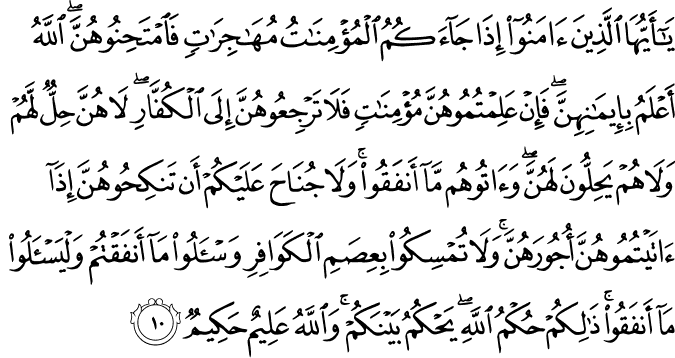
  • The terms of the treaty at Al-Hudaybiya were to return back to Mecca any Muslims who migrate to Medina. The Prophet (PBUH) honored those terms when Abu-Jandal migrated. He ordered him back. Then a woman, said in one report to be Umm Kulthoom bint `Uqba migrated. The Prophet (PBUH) was about to order her back when the revelation came,

    The flaw with this example is that it is not a case of abrogation, but of detailing a technicality. The treaty did not address women. Al-Khazraji, in his book نفس الصباح في غريب القرآن وناسخه ومنسوخه, volume 2, page 710, reports a hadeeth of the Prophet, peace be upon him, in which a woman named Sabee`a bint Al-Harth migrated to Medina as a Muslim. Her polytheist husband came after her and demanded that the Prophet return her to him. He said, "That was our condition to you and the seal has not yet dried." The Prophet gave the husband back his dowry and did not return the wife. He said, "Your condition was for men, not women."

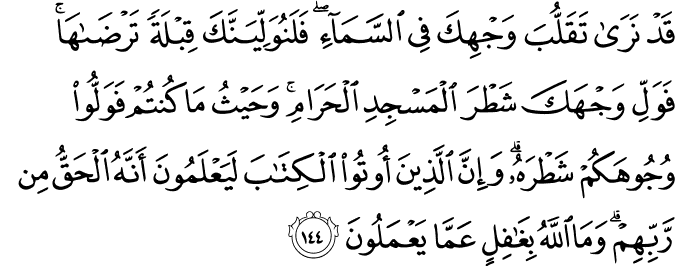
  • Muslims initially faced Jerusalem in prayer, then God revealed

    The flaw with this example is that there is no evidence that the initial Qibla (prayer direction) was by command from God. In fact, there was no Qibla specified at all at first. The command in 2:144 is new legislation.

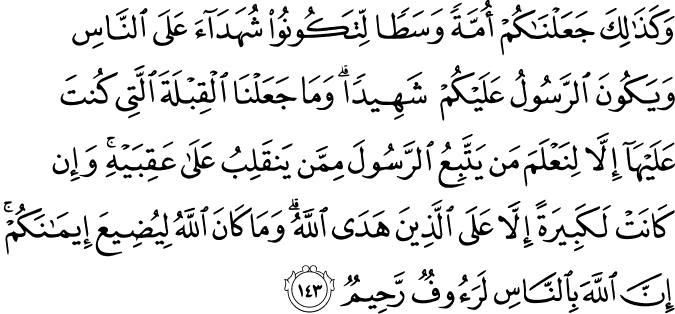
    Jamaal `Ataaya, in his book حقيقة النسخ وطلاقة النص في القرآن, pages 116-117, discusses this example. He tackles the claim that

    means it was a prior order from God. He argues that the verb جعلنا does not mean "We commanded," but rather "We let." That is because the verb means a continuation of something, while a command means a change. I'd add that the phrase that follows, التي كنت عليها (which you were on) clearly make the point that was a practice of the Prophet (PBUH) that God let go on for a while.

    `Ataaya quoted Ash-Shaatibi from his book Al-Muwafaqaat saying, "The foundationists (الأصوليون) have agreed that abrogation does not apply to what's been allowed by default (حكم الأصل)."

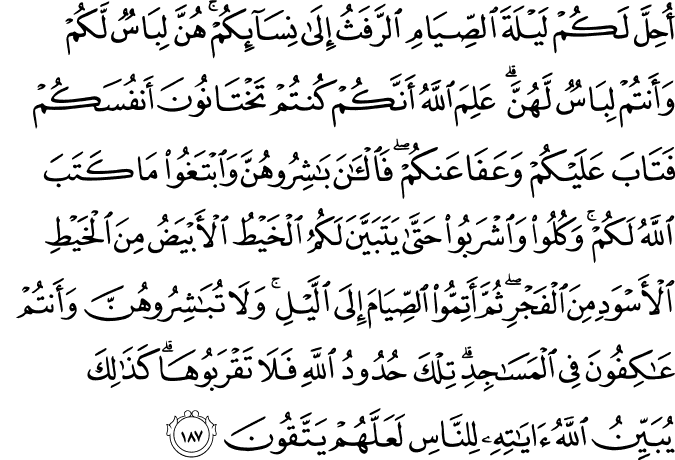
  • Muslims did not mate with their wives in Ramadhaan. Then God revealed,

    The flaw with this example, again, is that there was no order from God initially to abstain in Ramadhaan. Muslims did that on their own. 2:187 came to correct their misunderstanding. See more discussion about this case in the topic "Did 2:187 abrogate 2:183?"

  • Fasting the tenth day of Muharram (`Aashooraa') was mandated at first then abrogated by the Ramadhaan fast. The flaw with this example is that the `Aashooraa' fast was not a mandate from God, but an idea the Prophet (PBUH) liked very much. He was reported to have noticed, right after migration to Medina, that the Jews fasted that day. He asked them about the background of this practice. They told him it was a great day when God saved Moses from his enemies. He replied, "We belong to Moses more than you do!" And he fasted that day and ordered his followers to fast it. Reported by Al-Bulhaari and narrated by Ibn Abbaas, may God have been pleased with him. In fact, many versions of the hadeeth, narrated by `Aa'isha, may God have been pleased with her, and also reported by Al-Bukhaari, say it was the pagans of Mecca who fasted that day! The scholars did not agree what the day was either: some said it was the ninth, others said it was the tenth, and still others said it was both days.

  • Fear prayer, detailed in the Quran, abrogated the allowance for delaying prayers at battle times. Again, there is no evidence that delaying the prayer at battle times was by command from God.

There are many other examples one can think of, but none of them is a case of abrogation of a God-inspired order by the Prophet (PBUH). Everyone of those examples is either a case of correction of an opinion or new legislation.

To put it in simpler terms, it would be abrogation only if a Sunna says, "God has ordered me to order you to do X", then, later a verse is revealed saying "God orders you not to do X anymore but do Y instead." That never happened.
_________________
A candle loses nothing by lighting another candle.


Top
 Profile  
 
 Post subject: Re: Scholars opinions about abrogation
PostPosted: 02 Aug 2010, 18:33 
Offline
Site Admin
User avatar

Joined: 04 May 2009, 16:10
Posts: 4558
Location: USA
In his book نفس الصباح في غريب القرآن وناسخه ومنسوخه, volume 1, page 36, Abu-Ja`far Al-Khazraji reports the shock of Ibn Al-Jawzi after studying what scholars have written about abrogation. He wrote, "But I skipped the verses claimed abrogated with writings that only waste time in the worst way, such as what As-Suddi said when he claimed that

was abrogated by

And so on."

Al-Khazraji was one of those scholars who thought that reducing the number of abrogation cases is the right thing to do. I wonder why they didn't ask themselves the logical question, "What difference does it make if the number of abrogation cases is five instead of five hundred?" Both are the result of opinion, not proof.

In fact, the question they should have asked is whether abrogation at all. Al-Khazraji writes what I'm sure is the reason why most scholars chose to side by the abrogation doctrine instead of pointing out its fallacy. He wrote (my translation),

Abu-Ja`far Al-Khazraji wrote:
On the other hand, denial of abrogation is striking out all the narrations, reports and books that reached us from the righteous predecessors, one generation after another. It casts doubt on their knowledge and heritage. It is a departure from the consensus of the leaders and scholars of the community.

I think it is crucial to address this concern. Two points are raised,

  1. Is it right to dismiss a massive body of work? Can so many people all be wrong?

    My humble answer to this point is that a consensus can be wrong. We know what the consensus of the Church is regarding the nature of God. Does such consensus make it right? We know what is right and what is wrong in three ways:

    1. Revelation from God,
    2. Scientific experiments,
    3. Sound deduction.

    Thus, if a massive body of work by honorable scholars does not have a revelation from God to back up their conclusions, cannot apply the scientific method to their research, and have not used proper analysis, then their conclusions are wrong even if there are hundreds of them making the same conclusions.

    This is doubly important when the conclusions will annul or replace rulings of God. Pointing out that they were wrong and showing why is a duty.

    The merit of any conclusion is not that many people agree to it; it's that its deduction is sound.

  2. Is it proper to dissent from consensus? Is dissension a repudiation?

    Dissension is not repudiation. It does not accuse anybody of ignorance. It does not belittle any one. People reach wrong conclusions for hundreds of reasons. The Prophet, peace be upon him, assured us that those who work at analysis and get it wrong have a reward for their due diligence, and those who get it right get a double reward for the good they lead to by their correct conclusions.

    Nobody likes to be the odd man out. In fact, that's a major reason why consensus builds! People want to join the popular opinion, the winning team. It is the safer thing to do, most people think. People seek approval by their peers. We are social beings.

    But if the popular opinion means annulling or replacing the rulings of God, then it should be opposed loudly. God sent down His verses to be followed, not to be shelved.

_________________
A candle loses nothing by lighting another candle.


Top
 Profile  
 
 Post subject: Re: Scholars opinions about abrogation
PostPosted: 06 Aug 2010, 11:12 
Offline
User avatar

Joined: 05 May 2009, 00:16
Posts: 1839
Location: USA
Linguistic wrote:
`Ataaya, in his book حقيقة النسخ وطلاقة النص في القرآن, page 21, quotes renowned Dr. Yoosuf Al-Qaradhaawi from his book كيف نتعامل مع القرآن العظيم (How do we treat the Grand Quran), saying,

"One of the pitfalls to mention here regarding understanding of the Quran and its exegesis is the claim of abrogation of any of its verses, without certainty of proof that makes such abrogation necessary. God sent down the Book so that it is followed, its commands executed, its prohibitions avoided, its limits respected. This is the basis in the verses of the Quran; that they are set (محكمة), lasting, mandatory, obligatory on everyone who believes in God and His Messenger. There can be no exit from this basis except with certitude in which there is no doubt or probability. The call for abrogation of a verse or a part of a verse without certitude of evidence is rejected."

Great articulation of the reasoning behind the burden of proof.

_________________
To translate is the best way to understand


Top
 Profile  
 
Display posts from previous:  Sort by  
Forum locked This topic is locked, you cannot edit posts or make further replies.  [ 194 posts ]  Go to page Previous  1 ... 5, 6, 7, 8, 9, 10, 11 ... 20  Next


Who is online

Users browsing this forum: No registered users and 1 guest


You cannot post new topics in this forum
You cannot reply to topics in this forum
You cannot edit your posts in this forum
You cannot delete your posts in this forum
You cannot post attachments in this forum

Search for:
Jump to:  
cron
It is currently 15 May 2026, 14:58

All times are UTC

Powered by phpBB © 2000, 2002, 2005, 2007 phpBB Group