Opinion of Imam Al-Shafeiy
...
Therefore, Al-Shafeiy's main efforts can be seen as attempts to restrict something that has gone out of control, and to put discipline in it. His views on abrogation may be viewed in the same light since the notion had been expanded as well by the Hanafi school. This may explain the rather unusual dichotomy that Al-Shafeiy pioneered in insisting that Quran abrogates Quran and Sunna abrogates Sunna but no cross abrogation of any kind is allowed (although the author on page 100 says that Al-Shafeiy doesn't explicitly say that Quran cannot abrogate Sunna, but that he says explicitly that Sunna cannot abrogate Quran). Precluding that Quran could abrogate Sunna is a somewhat unusual condition for someone who believes in the principle of abrogation in the first place, and it can be seen as an attempt to preempt relegating the Sunna to being less authoritative, something Al-Shafeiy was keen on avoiding. Disclaimer: The last three paragraphs in this post are based on non-Muslim analysis of events, and should be viewed in this light.
His reasoning was that the Sunna's purpose is to explain the Quran and it can't do that if the Quran keeps invalidating it.
However, it appears that Ash-Shaafi`i changed his view later, as reported in البحر المحيط by Az-Zarkashi. Dr. Ali Juma`a pointed that out in his book النسخ عند الأصوليين, page 91 footnotes. Indeed, Ash-Shaafi`i was reported to have changed many of his rulings later.
I find it interesting that the evidence cited most often in the literature to prove that the Quran did abrogate the Sunna is all flawed! As will become clear from the following examples cited, what they mean by Sunna is opinions of the prophet, peace be upon him, not instructions from God to him. Is that Sunna or is it opinion? There has to be a distinction between prophetic orders which convey God's orders and orders that the Prophet (PBUH) initiated on his own.
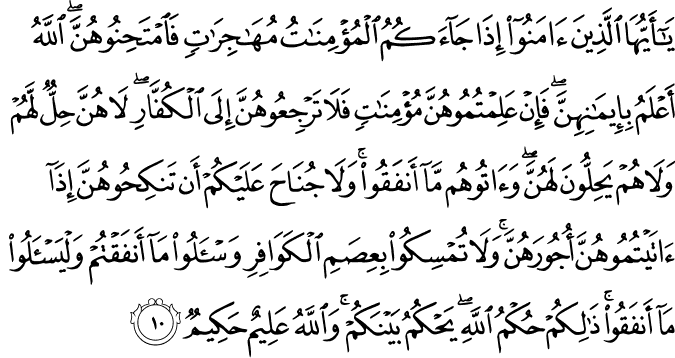
- The terms of the treaty at Al-Hudaybiya were to return back to Mecca any Muslims who migrate to Medina. The Prophet (PBUH) honored those terms when Abu-Jandal migrated. He ordered him back. Then a woman, said in one report to be Umm Kulthoom bint `Uqba migrated. The Prophet (PBUH) was about to order her back when the revelation came,
The flaw with this example is that it is not a case of abrogation, but of detailing a technicality. The treaty did not address women. Al-Khazraji, in his book نفس الصباح في غريب القرآن وناسخه ومنسوخه, volume 2, page 710, reports a hadeeth of the Prophet, peace be upon him, in which a woman named Sabee`a bint Al-Harth migrated to Medina as a Muslim. Her polytheist husband came after her and demanded that the Prophet return her to him. He said, "That was our condition to you and the seal has not yet dried." The Prophet gave the husband back his dowry and did not return the wife. He said, "Your condition was for men, not women."
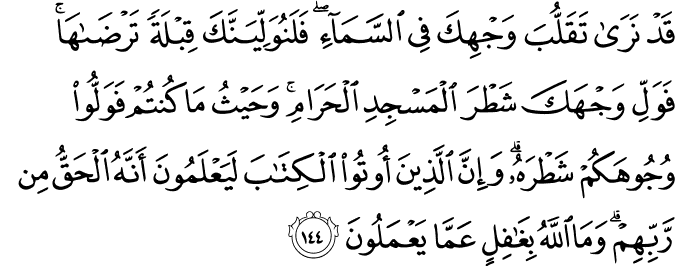
- Muslims initially faced Jerusalem in prayer, then God revealed
The flaw with this example is that there is no evidence that the initial Qibla (prayer direction) was by command from God. In fact, there was no Qibla specified at all at first. The command in 2:144 is new legislation.
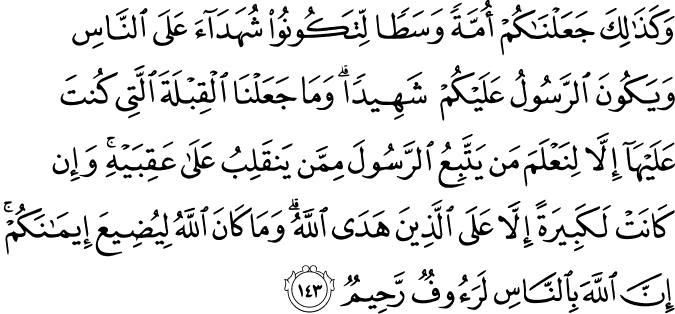
Jamaal `Ataaya, in his book حقيقة النسخ وطلاقة النص في القرآن, pages 116-117, discusses this example. He tackles the claim that
means it was a prior order from God. He argues that the verb جعلنا does not mean "We commanded," but rather "We let." That is because the verb means a continuation of something, while a command means a change. I'd add that the phrase that follows, التي كنت عليها (which you were on) clearly make the point that was a practice of the Prophet (PBUH) that God let go on for a while.
`Ataaya quoted Ash-Shaatibi from his book Al-Muwafaqaat saying, "The foundationists (الأصوليون) have agreed that abrogation does not apply to what's been allowed by default (حكم الأصل)."
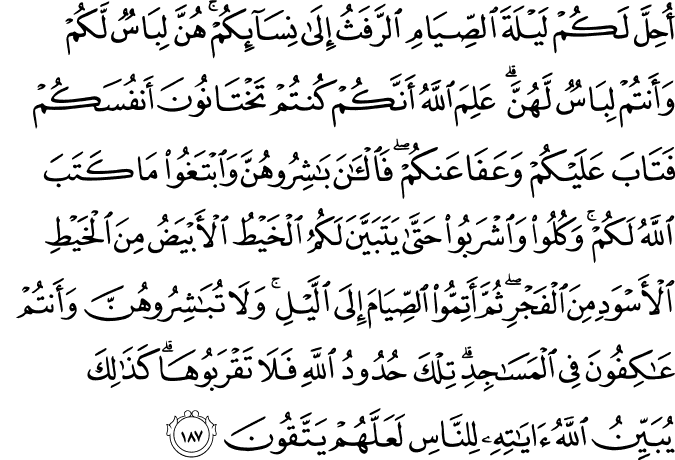
- Muslims did not mate with their wives in Ramadhaan. Then God revealed,
The flaw with this example, again, is that there was no order from God initially to abstain in Ramadhaan. Muslims did that on their own. 2:187 came to correct their misunderstanding. See more discussion about this case in the topic "Did 2:187 abrogate 2:183?"
- Fasting the tenth day of Muharram (`Aashooraa') was mandated at first then abrogated by the Ramadhaan fast. The flaw with this example is that the `Aashooraa' fast was not a mandate from God, but an idea the Prophet (PBUH) liked very much. He was reported to have noticed, right after migration to Medina, that the Jews fasted that day. He asked them about the background of this practice. They told him it was a great day when God saved Moses from his enemies. He replied, "We belong to Moses more than you do!" And he fasted that day and ordered his followers to fast it. Reported by Al-Bulhaari and narrated by Ibn Abbaas, may God have been pleased with him. In fact, many versions of the hadeeth, narrated by `Aa'isha, may God have been pleased with her, and also reported by Al-Bukhaari, say it was the pagans of Mecca who fasted that day! The scholars did not agree what the day was either: some said it was the ninth, others said it was the tenth, and still others said it was both days.
- Fear prayer, detailed in the Quran, abrogated the allowance for delaying prayers at battle times. Again, there is no evidence that delaying the prayer at battle times was by command from God.
There are many other examples one can think of, but none of them is a case of abrogation of a God-inspired order by the Prophet (PBUH). Everyone of those examples is either a case of correction of an opinion or new legislation.
To put it in simpler terms, it would be abrogation only if a Sunna says, "
God has ordered me to order you to do X", then, later a verse is revealed saying "God orders you not to do X anymore but do Y instead." That never happened.


 Login
Login Questions
 Search