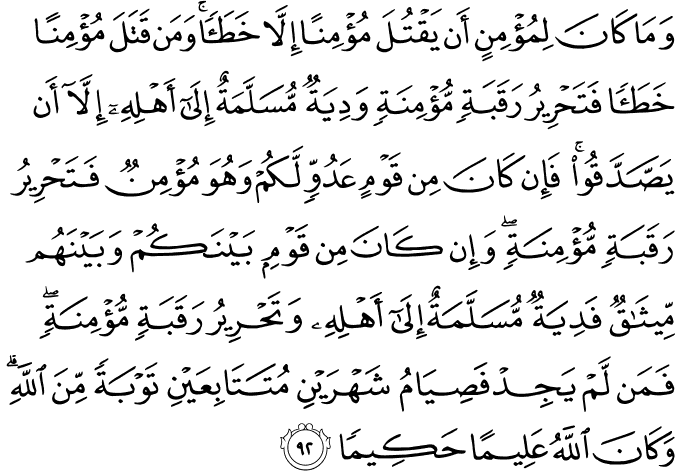
Ibn Hazm Al-Andalusi writes that the last sentence in
Was abrogated by
I assume that the perceived conflict here is that the people named in 4:92 include polytheists, thus 4:92 states that treaties with them must be honored, while 9:1 ends all treaties with the polytheist.
There are at least two problems with this claim of abrogation:
- The sentence in 4:92 is conditional, "if there is a covenant between Muslims and others, then ..." 9:1 forbids any more treaties, therefore the condition of 4:92 will never again be true.
- The verse is clearly about negligent homicide of a Muslim. It does not address negligent homicide of a polytheist.
It is important to clear up such misunderstanding. Verse 4:92 speaks of three different victims of negligent homicide,
- A Muslim in the community. In this case, the punitive damages are freeing of a Muslim slave and a ransom to the victim's family.
- A Muslim living among the enemy. The punitive damages here are freeing of a Muslim slave. No ransom.
- A Muslim living among covenanted people. They may or may not be an enemy. The punitive damages here are like the first case: Freeing of a Muslim slave and a ransom to the victim's family.
It is that last category that may seem in conflict with 9:1, but that's not the case. Verse 9:1 forbids making any more peace treaties with hostile polytheists. As I said above, that makes the third case in 4:92 academic. Subsequent verses in Chapter 9 elaborate what 9:1 means. They state that peaceful polytheists are to be left alone, even protected. For such people, the second case above in 4:92 applies.
One final word. I am surprised that this case is not claimed by more scholars! The case here is stronger than many cases claimed elsewhere, yet this case is not mentioned in the prominent abrogation publications. I wonder why.


 Login
Login Questions
 Search