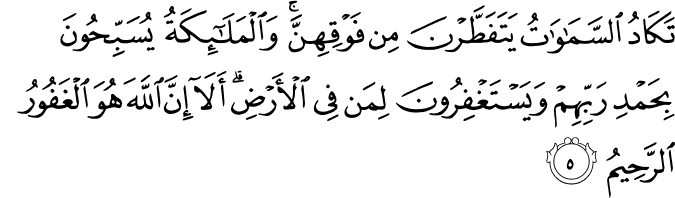
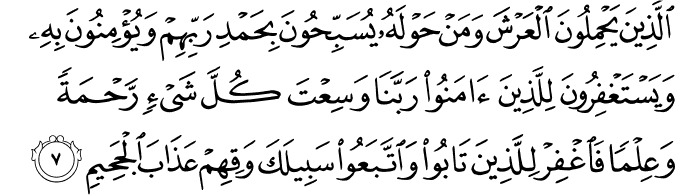
As-Suyooti reported that Makki has said that 40:7 abrogated 42:5, which, he said, is the only abrogation case of Meccan verses. As-Suyooti corrected him by giving the example of
73:20/73:2-4. While abrogation in the 40:7/42:5 case, if it can be proven, carries no consequence to the law as the two verses do not contain rulings, we still include it in the discussion because we do want to encompass all claims of abrogation of verses that have remained in the Quran. Here are the two verses in this case,
is claimed to have been abrogated by
To begin with, Chapter 42 is recognized to have been revealed after Chapter 40, so the abrogation claim is weakened by chronology. Besides, both verses are statements of fact, and thus cannot be abrogated. In addition, 40:7 does not say that the angels stopped "praying for those on earth." In other words, the angels may very well be praying for all people on earth but perhaps more for the believers. I do not see abrogation here for those reasons. God knows best.
Moreover, 40:7 speaks of special angels, those who carry the Throne and those around them. That is an elect group. It may be that this elect group can only pray for the believers and repenters, but the rest of the angels are permitted to pray for sinners and disbelievers too. With this apparent explanation, there is no contradiction and therefore no need to claim abrogation.
Another plausible explanation is that 42:5
includes believers and 40:7
does not exclude disbelievers, therefore there is no conflict to resolve between the two.


 Login
Login Questions
 Search