TheMostReadBook.org

An English translation of the Quran that is as close as possible to the Arabic sacred text
View active topics
  Verse(s):    
View unanswered posts


Forum locked This topic is locked, you cannot edit posts or make further replies.  [ 7 posts ] 
Author Message
 Post subject: Did 2:193 abrogate 2:191?
PostPosted: 31 Jan 2010, 01:33 
Offline
Site Admin
User avatar

Joined: 04 May 2009, 16:10
Posts: 4558
Location: USA
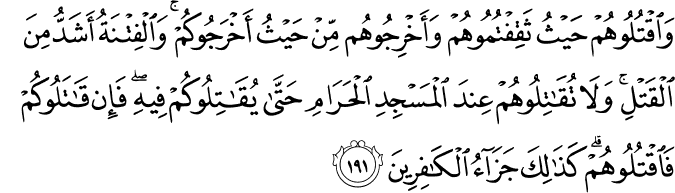
This case is not quoted often. It is about fighting at the Sacred Mosque. Here are the two verses,

is claimed to have been abrogated by

I don't see where abrogation can be claimed. 2:191 says that fighting at the Sacred Mosque is allowed in self defense, while 2:193 says that fighting is for the prevention of sedition. I guess the people who saw an abrogation here thought that 2:193 gave permission to fight at the Sacred Mosque or anywhere else until no fear of sedition is there, while 2:191 prohibited that except in self defense.

I see this as yet another example of two verses completing the instruction, not contradicting each other. The instruction is:

Fighting anywhere is only to prevent sedition. Causing sedition is an attack on Muslims that justifies fighting anywhere, including the Sacred Mosque. However, fighting at the Sacred Mosque must be avoided unless the enemy fight Muslims there. As soon as the enemy ceases causing sedition, Muslims should also cease fighting.

Such instruction is sensible and cohesive and validates 2:191 and 2:193 both. A claim of abrogation is therefore unnecessary.

See also a brief mention of this claim in this post where Dr. Mustafa Zayd reports that Ar-Rabee` ibn Anas made the claim and Dr. Zayd refutes it.

_________________
A candle loses nothing by lighting another candle.


Top
 Profile  
 
 Post subject: Who said what
PostPosted: 31 Jan 2010, 01:37 
Offline
Site Admin
User avatar

Joined: 04 May 2009, 16:10
Posts: 4558
Location: USA
For:
Qataada (who said the abrogating is the sword verse),
Ar-Rabee` ibn Anas (according to Dr. Zayd),
Maalik,
Abdullah ibn Hamza Aş-Şa`di Al-Yamaani,
Ash-Shaafi`i,
An-Nahhaas,
Makki,
Ibn Hazm Al-Andalusi,
Ibn Salaama.

Against:
Mujaahid,
Taawoos,
Ibn Al-Jawzi,
Al-Aloosi,
Ar-Raazi,
Ibn Al-Arabi,
Al-Qurtubi,
As-Suyooti,
Az-Zurqaani,
Al-Asfahaani,
Dr. Mustafa Zayd,
Dr. Ahmad Hijaazi As-Saqqa,
Dr. Az-Zalmi,
Ihab Hasan Abduh,
Dr. Ali Jum`a.

_________________
A candle loses nothing by lighting another candle.


Top
 Profile  
 
 Post subject: Re: Did 2:193 abrogate 2:191?
PostPosted: 31 Jan 2010, 06:41 
Offline
User avatar

Joined: 05 May 2009, 00:16
Posts: 1839
Location: USA
Linguistic wrote:
I don't see where abrogation can be claimed.

I don't either, and here is my argument. A principal meaning of "الفتنة" (the word translated as sedition) is being forced against one's religion. Verse 2:191 states that "الفتنة" is more severe than being killed. When the verse prohibits fighting at the Sacred Mosque, it makes an exception if the enemy fights us there first. Putting the two together, if "الفتنة" is worse than being killed, then if the enemy tries to force us against our religion, that's even more severe than trying to kill us which is what fighting means. Clearly we can fight back, which is precisely what verse 2:193 tells us to do; fighting to avert "الفتنة" , but stopping if the enemy stops, which implies that they started it, exactly what verse 2:191 requires in order to allow us to fight at the Sacred Mosque. This is agreement between the two verses, not abrogation.

_________________
To translate is the best way to understand


Top
 Profile  
 
 Post subject: Did 2:191 abrogate itself?
PostPosted: 03 Apr 2010, 21:07 
Offline
Site Admin
User avatar

Joined: 04 May 2009, 16:10
Posts: 4558
Location: USA
Ibn Hazm Al-Andalusi actually writes that 2:191 abrogated itself! He wrote in his book الناسخ والمنسوخ في القرآن الكريم that the latter part, فإن قاتلوكم فاقتلوهم (but if they fight you then kill them) abrogated the first part.

Isn't it obvious that the latter part confirms the contingency حتى يقاتلوكم فيه (until they fight you there) of the first part? Doesn't this verse make the following consistent command:

"Fighting at the Sacrosanct Mosque is forbidden unless the enemy fights you there, in which case you have to defend yourselves by fighting them back and killing them even if the fight is at the Sacrosanct Mosque. You had to. They are the ones who brought the fight to the Sacrosanct Mosque."

_________________
A candle loses nothing by lighting another candle.


Top
 Profile  
 
 Post subject: Re: Did 2:191 abrogate itself?
PostPosted: 04 Apr 2010, 07:18 
Offline
User avatar

Joined: 05 May 2009, 00:16
Posts: 1839
Location: USA
Linguistic wrote:
Isn't it obvious that the latter part confirms the contingency حتى يقاتلوكم فيه (until they fight you there) of the first part?

It's obvious to me.

_________________
To translate is the best way to understand


Top
 Profile  
 
 Post subject: Re: Did 2:193 abrogate 2:191?
PostPosted: 27 Jul 2010, 02:40 
Offline
Site Admin
User avatar

Joined: 04 May 2009, 16:10
Posts: 4558
Location: USA
Dr. Ali Jum`a rejects this claim in his book النسخ عند الأصوليين, page 81 for the same obvious reason mentioned above: that initiating a fight at the Sacrosanct Mosque is forbidden. He says that The Hanafis forbid the killing of a disbeliever who takes sanctuary there unless he fought Muslims there. They also forbid the killing of anyone who takes sanctuary there even if they had killed elsewhere.

Dr. Jum`a points out that 2:193 is a continuation of the theme started in 2:191 and that it explains the purpose of the fight in the first place, namely, prevention of persecution in religion and self defense. 2:193 further uses the same purpose to define the rule for ending the fight: the enemy stops persecution in religion and stops aggression.

_________________
A candle loses nothing by lighting another candle.


Top
 Profile  
 
 Post subject: Re: Did 2:193 abrogate 2:191?
PostPosted: 05 Aug 2010, 19:42 
Offline
Site Admin
User avatar

Joined: 04 May 2009, 16:10
Posts: 4558
Location: USA
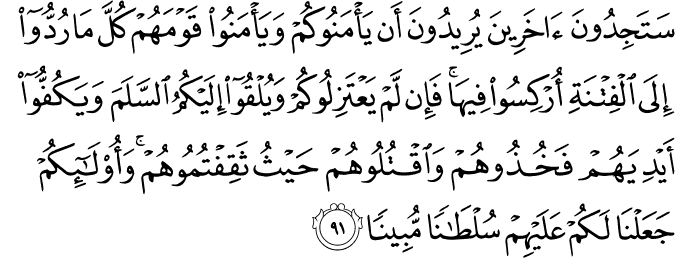
Al-Khazraji, in his book نفس الصباح في غريب القرآن وناسخه ومنسوخه, volume 1, pages 215-216, reports that Ismail ibn Aws has stated that 2:191 is actually an abrogating verse. He said it abrogated

How can that be, when verse 4:91 says that the fight is only called for, regardless of place, when the enemy does not observe the terms of peace, which is exactly what the 2:191 says?

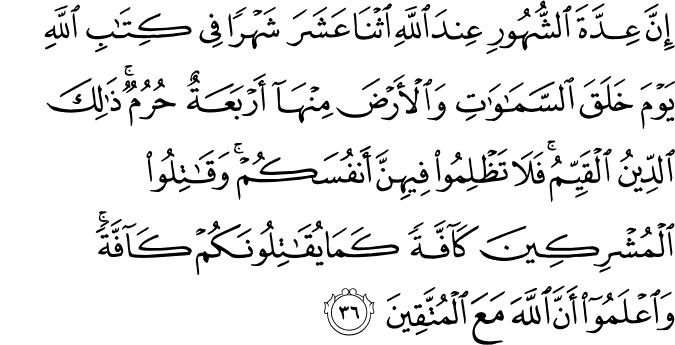
Qataada said 2:191 was abrogated by the sword verse. Others have said it was abrogated by 9:36,

which some scholars have meant when they referred to the sword verse.

Once again, it is obvious that the pro-abrogation folk were unable to see how each verse addresses a specific point and that all of them together make up the ruling. This is emblematic of most abrogation claims.

Verse 2:191 establishes the sanctity of the Sacrosanct Mosque. It does not prohibit fighting in it unconditionally! It clearly says that fighting in it should be avoided but may be done only if Muslims are fought there. Then, it's self defense and not defiling of the place.

Verse 2:193 establishes the legitimate reason for fighting: ensuring that people will be free to choose Islam for a religion and that Muslims will not be persecuted. It does not mention anything about the Sacrosanct Mosque.

Verse 9:36 simply tells Muslims to unite against the enemy which is united against them. It does not mention the Sacrosanct Mosque.

Verse 9:5, the "sword" verse, as mentioned a million times already, does not give a Carte Blanche license to fight or kill. Only hostile polytheists. If they fight Muslims at the Sacrosanct Mosque then Muslims are ordered to fight and kill them even there.

Where is the inconsistency or contradiction in any of the above that requires a strange and serious claim such as abrogation? Was the above analysis really that hard to come by?
_________________
A candle loses nothing by lighting another candle.


Top
 Profile  
 
Display posts from previous:  Sort by  
Forum locked This topic is locked, you cannot edit posts or make further replies.  [ 7 posts ] 


Who is online

Users browsing this forum: No registered users and 2 guests


You cannot post new topics in this forum
You cannot reply to topics in this forum
You cannot edit your posts in this forum
You cannot delete your posts in this forum
You cannot post attachments in this forum

Search for:
Jump to:  
cron
It is currently 16 Mar 2026, 21:42

All times are UTC

Powered by phpBB © 2000, 2002, 2005, 2007 phpBB Group