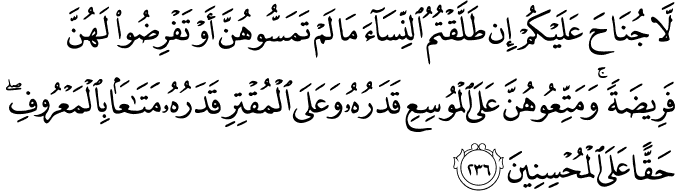
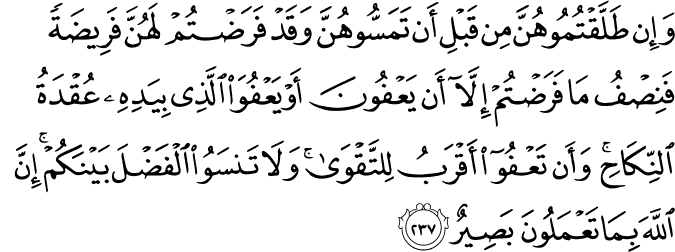
Al-Khazraji, in his book نفس الصباح في غريب القرآن وناسخه ومنسوخه, volume 1, page 231, says that
was abrogated by God by
He said that was said by Sa`eed ibn Al-Musayyib and reported by An-Nahhaas and Makki.
He neglected to say why he or Ibn Al-Musayyib thought so, nor whether An-Nahhaas or Makki commented on it. Call me old fashioned, but I think that it's improper for a Muslim author to declare a verse void and not even say why.
The two verses complement each other and together explain the ruling of God. Verse 2:236 tells men that if they divorce women before consummating the marriage and they have not named for them a dowry, that their only obligation toward their divorced wives is alimony. Verse 2:237 follows up on that to talk about the case if the marriage was not consummated
and a dowry was named. In this case, the man may pay only half of it, but the wife may forfeit it. Thus, we have two situations addressed by the two verses, both for a sexless marriage that ended in divorce:
- A dowry was named: In this case, the man is obligated to pay only half of it but the wife may forfeit. He still has to pay alimony.
- No dowry was named: In this case, obviously, only alimony is the man's obligation.
Those who ruled that alimony is always required include Al-Hasan Al-Basri, Abul-`Aaliya and Sa`eed ibn Jabeer. Some of the literature seems to bundle dowry and alimony together, and that's probably why some have thought this verse was abrogated. Among those were Al-Hasan. Abu-Bakr Al-Huzhali asked him if a man divorced his wife before he consummated the marriage and had promised her a dowry, does she get any Mataa' (alimony). Al-Hasan said, "Yes, by God! Don't you read 2:237?"
Other folks ruled that there is no alimony in the case of a named dowry. Those included Ibn Umar, Sa`eed ibn Al-Musayyib, Mujaahid, Qataada, `Ataa', Naafi` and Ibn Abi-Nujayh. Agreeing with them are Abu-Haneefa and his fellows, Ash-Shaafi`i, Ibn Hanbal, Al-Awzaa`i and Ibn Al`Arabi. But one narration attributed to Ibn Hanbal has him ruling that alimony is mandatory at all times. It appears that he was the only one who so ruled.
Ibn Shihaab Az-Zuhri ruled that alimony is mandatory if no dowry was named, and is only recommended if a dowry was named. Shurayh ruled that alimony is recommended in both cases and he always drew attention to the epilogue of the verse
حقا على المحسنين (a right upon the benevolent) and used to say, "Do not refuse to be of the benevolent!" I see his point. Upon the benevolent, it is required, therefore, upon others, it is only recommended. That is what drew the attention of Maalik, Al-Layth, Abuz-Zinaad and Ibn Abi-Layla too who agree with Shurayh. Dr. Zayd disagrees because, he says, the verse has a command
ومتعوهن (and give them alimony). He cites Ibn Qadaama saying the same thing. I don't see that as a valid argument, since a command may mean a recommendation and not a mandate. You only know it's a mandate if it is accompanied by strong indicators, such as a warning against violating the command.


 Login
Login Questions
 Search